
Lesson 1
INSTRUCTIONAL STEPS
1: INTRODUCE – What is Artificial Intelligence?
Duration: 15 minutes
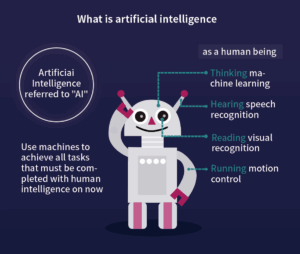
One of the founding fathers of artificial intelligence, John McCarthy defines the subject of artificial
intelligence as the “science and engineering of making intelligent machines, especially intelligent
computer programs”. Popular understanding of artificial intelligence (AI), it is a science and engineering
that be able to allow intelligence machines and computer programs to learn and solve problems in the
usual way as a human being, including the functions of replacing human beings in cognition, analysis,
decision-making etc., is essentially a simulation of the process of human consciousness and thinking.
Pioneer scientists in the field of artificial intelligence have dreamed that one day they will be able to
create machines that are as essential to human intelligence as “General AI,” but this dream is too far
away. After more than half a century of development, what we can achieve now is generally called
“Narrow AI”, it means that a machine can behave like a human being, or perform a specific task better
than a human being.
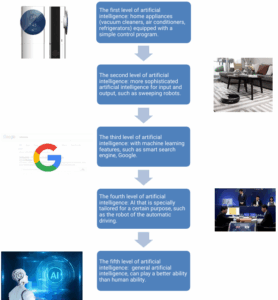
With the history of artificial intelligence, we can divide artificial intelligence into five levels.
2: INTRODUCE – Robot and Artificial Intelligence
Duration: 15 minutes
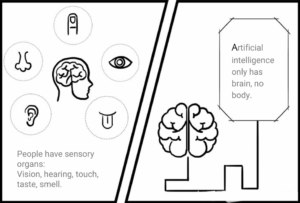
Have you seen the cartoon of Doraemon? Do you want to have a magical friend like Doraemon?
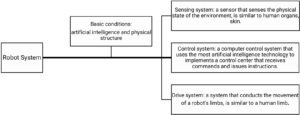
Organizations like this human-like body with wisdom and the ability to achieve the same dialogue,
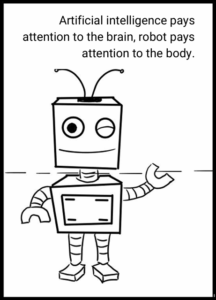
thinking and action are collectively referred to as robots. However, the study of artificial intelligence is
not equivalent to the study of robots.
3: INTRODUCE – Application of artificial intelligence
Duration: 15 minutes
According to the basic concept of artificial intelligence, it is a branch of computer science. Based on the
artificial intelligence, many different technical fields have been developed, such as computer vision,
machine learning, natural language processing, robotics, speech recognition technology, etc.
Computer vision is a feature that allows a machine to recognize a scene like a human eye and transmit
image signals to a processing system to extract targets. It is widely used in medical imaging analysis,
in the field of security and surveillance for identifying suspects.

Machine learning is referred to the ability of a computer system to not rely on the programmer’s program
instructions, but only rely on data to improve its performance. The more data the machine learns, the
more accurate the prediction will be. It is widely used in sales forecasting, inventory management,
natural gas exploration and other fields.

Natural language processing is referred to allow a computer as a human, have the same text processing
capabilities, such as extracting the meaning of an article, automatically identifying specific nouns in a
document, and reading the terms in a commercial contract and make a chart.
Applications of artificial intelligence in robots include the high-performance sensors, actuators and
other hardware, that integrating cognitive technologies such as machine vision and automated path
planning, to help humans accomplish many difficult tasks, such as unmanned aerial vehicle technology
and driverless car technology and so on.

Speech recognition is referred to the language technology that allows computers to automatically and
accurately transcribe from humans. It is mainly used in voice writing, voice control, and telephone
customer service, etc.

STEP 4: SHARE – Self-exploration
Duration: 5 minutes
Please answer the following questions after checking the information.
1. How does humans control artificial intelligence through programming?
2. In addition to the artificial intelligence used in robots, what different forms of artificial intelligence can
be used? For example, artificial intelligence in computers, artificial intelligence in mobile phones, etc.
3. What artificial intelligence technologies are available to you in your life?